ResponseFunctions example code
from obspy.core.stream import read
from obspy.core.inventory import read_inventory
from tiskitpy import SpectralDensity, ResponseFunctions

# Read in the data and metadata, and calculate a SpectralDensity
stream = read('data/XS.S11D.LH.2016.12.11.mseed', 'MSEED')
inv = read_inventory('data/XS.S11_decimated.station.xml', 'STATIONXML')
sd = SpectralDensity.from_stream(stream, inv=inv)

# Calculate the response functions with respect to the 'LDH' channel
rfs = ResponseFunctions(sd, '*H')

# Print the ResponseFunctions
print(rfs)
ResponseFunctions object:
    input_channel='XS.S11D..LDH'
    output_channels=['XS.S11D..LDH', 'XS.S11D..LH1', 'XS.S11D..LH2', 'XS.S11D..LHZ']
    noise_channels=['output', 'output', 'output', 'output']
    n_windows=81
# Plot the ResponseFunctions
rfs.plot()
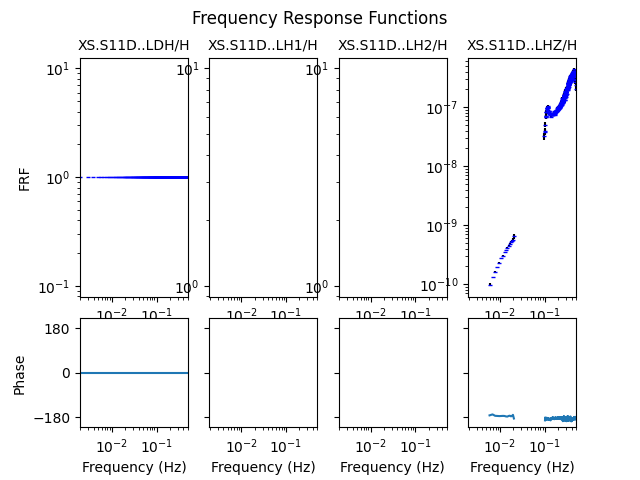
The response_function only plots where there is significant coherence between the two channels. in this example, the pressure channel (LDH) only has a viable frequency response function with:
itself (duh, with a value of 1)
the vertical channel, in the compliance and microseism bands